
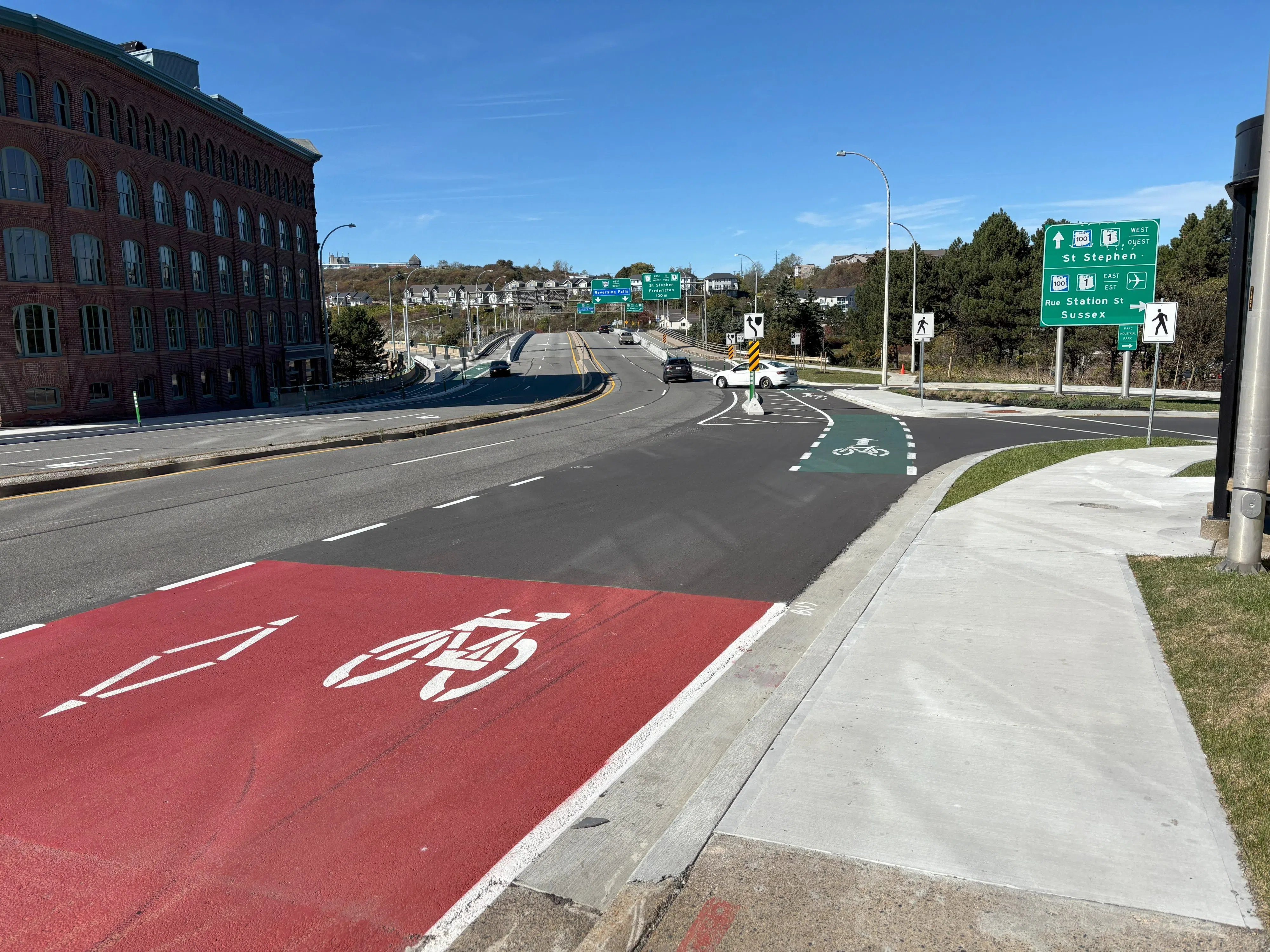
New bike lanes in Saint John are already drawing more people onto the streets, according to city officials.
Municipal traffic engineer Jill DeMerchant said the city has seen more cyclists and even e‑scooter riders using the new lanes on Main Street and City Road, with work on Station Street still underway.
“We were seeing a lot more cyclists and all different road users,” DeMerchant said.
“There’s a lot of those e‑scooters out now and those folks are using the bike lanes, which is great. So it provides that safe space for them, and now that people can see it’s being used, they see that it’s a valuable project.”
She said the projects were designed as “complete streets,” with upgrades for pedestrians and accessibility as well as protected cycling lanes.
The city worked with its Accessibility Advisory Committee on the Main Street design, which DeMerchant said has been welcomed by residents.
The upgrades are part of Move SJ, the city’s transportation plan. DeMerchant said the strategy includes a cycling network that will eventually stretch 67 kilometres.
“We’re at 35 right now, so we’re about halfway,” she said.
She added that connecting the network will make cycling more practical for residents and help the city reach its goal of having 20 per cent of trips made by sustainable transportation. “We’re estimating about eight per cent right now,” she said.
DeMerchant said Main Street was a priority because it links the north end, old north end and uptown areas with many residents who do not own vehicles.
She said the corridor also includes key transit stops that were incorporated into the design.
The city is also looking ahead to other projects. DeMerchant said plans include extensions to Harbour Passage on the west side and from the south Central Peninsula to Rockwood Park.
She said the city also tries to add bike lanes during other roadwork, such as the recent reconstruction of Broad Street, where cycling and pedestrian facilities were included.
She acknowledged there were challenges in planning, especially on Main Street, which is a provincial highway that crosses Route 1.
“That just creates some challenges because there are different bodies that need to be represented,” she said.
“But in the end, we all have the same goal of getting people around safely.”


