
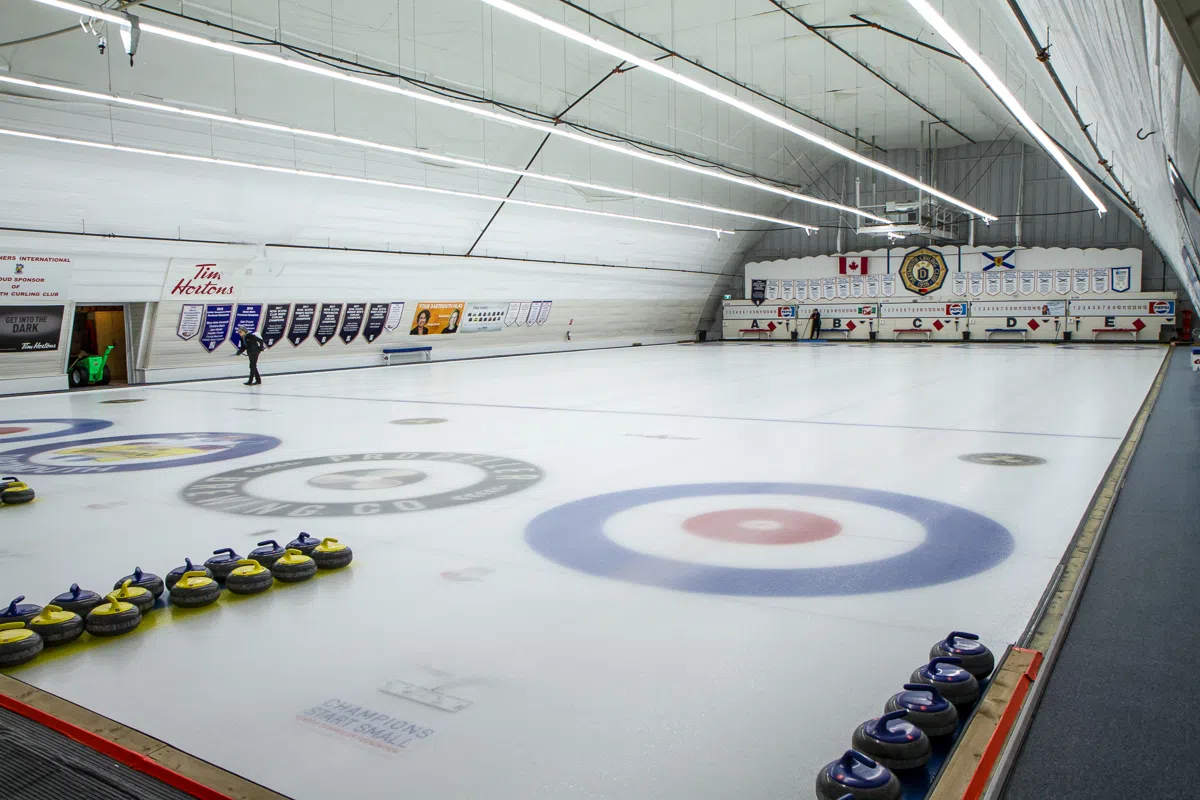
The Dartmouth Curling Club is indefinitely closed after a major leak made it impossible to make the ice.
They have tried several options, but they do not know exactly where the leak is, and they are not sure how to find it, other than by tearing up the concrete to see the pipes underneath.
But Cathy Dalziel, president of the non-profit club, says that is too expensive.
“I don’t think we have enough money to even do a proper investigation of what has caused this leak. So yeah, we’re in a pickle a little bit,” said Dalziel.
She added that they are exploring several options, like looking at getting grants from the province, reaching out to city council, potentially fundraising, and using special equipment that would let them create ice in a different way.
Too difficult to find leak
The club shut down at the end of the season in April and let the ice melt and removed the brine, the mixture they use to make the ice.
Later, they started a large project, Dalziel said, to replace some chiller barrels with the help of a contractor.
But when the project was done and they turned their ice-making system back on in September, the brine was disappearing way faster than it should. When it got worse, they knew they were dealing with a leak.
They went back and made sure they did not create the leak when the new chiller barrels went in. She says they have a very trusted contractor working with them, and the barrels seem to have no connection to the leak.
That means it could be in the pipes under the cement floor, which sits under the entire surface of the ice. To get under there, they would have to jackhammer up the cement and see what’s going on.
“So we’ve done as best as we can to figure it out, and we are at a loss to know what those leaks are all about. Whether we have one, whether we have 10, who knows?” said Dalziel.
Construction could have caused it, says club president
Dalziel says their best guess is that the leak is on the side opposite the chiller barrels.
Outside, there has been a lot of construction since April, but they have no clear connection between that work and the leak.
“There has been a lot of shake, rattle and roll as they’ve moved earth and rock,” says Dalziel.
“We certainly knew that the building was shaking a little bit. But, you know, until someone actually digs it all up, we don’t know what caused it.”
Club exploring options
Although they tried to put the ice in despite the leak, one of their compressors broke, and they feared something might happen to the other one, so they decided to cancel the season.
They are considering trying a sealant. They would put it through the pipes, and it would seal any holes, but she says the leak is so huge that sealant may not be able to fix the problem.
“It would be kind of administering a Hail Mary,” says Dalziel.
An ice grid is another option. A company from Germany makes a sort of grid of pipe that can click together and is easily assembled, she says, but it is still expensive. But it is used by the U.S. Curling Association, as well as the Olympic Curling Association.
When the season had to be canceled, Dalziel says their first priority was returning the fees paid by members. But they will reach out to members and anyone else interested and ask if they could donate.
“We still have a building, at the end of the day, that we might be able to figure out, well, someone else might want to rent the shed now that it doesn’t have ice. And what can we do as an alternative use of this building, while we figure this out,” says Dalziel.



