
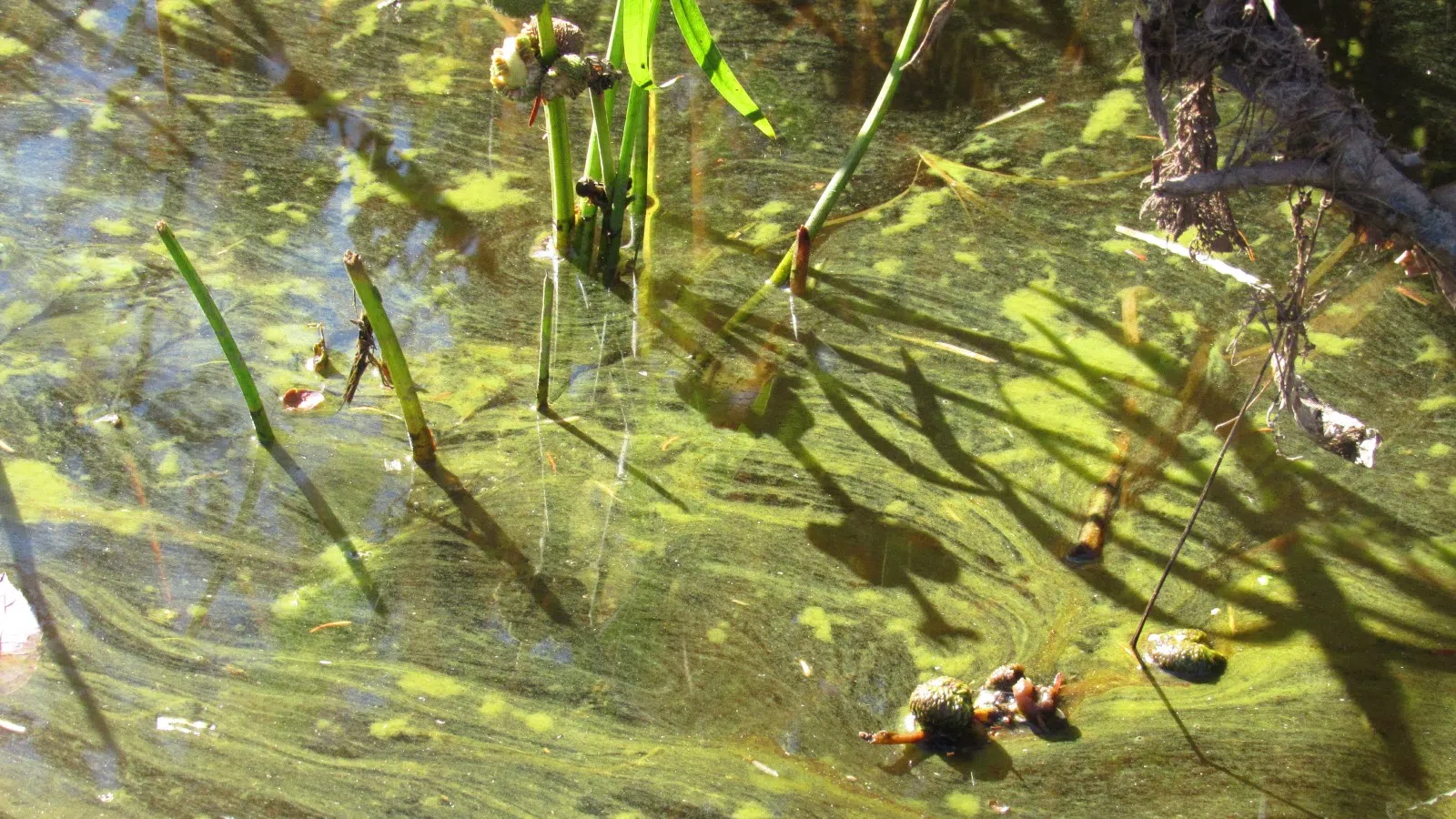
Recreational activities at the Irishtown Nature Park reservoir in Moncton are off-limits until further notice.
The closure comes after recent testing revealed cyanobacteria, or blue-green algae, within the reservoir.
According to an advisory on the Public Health website, the latest bloom was confirmed on June 24.
A city spokesperson told our newsroom that the reservoir was closed for recreational activities three days later.
“Samples are collected and actions are taken once results are received,” Maeve Murphy wrote in an email.
Although most cyanobacteria are not dangerous, some strains release toxins that are harmful to humans and animals. These toxins can irritate the skin, eyes, and throat, and may cause stomach discomfort if they are swallowed.
Surface blooms typically appear blue-green but can also be green, red, or brown, according to the province. Benthic mats form along the bottom of lakes and rivers and often wash ashore in dark hues, posing a particular threat to pets.
First advisory issued in 2008
Cyanobacteria advisories are in place for several New Brunswick waterways. In the case of the Irishtown Nature Park reservoir, the advisory was first issued in Aug. 2008.
Public Health said in a note on its website that advisories remain in place indefinitely due to the unpredictability of cyanobacteria blooms.
“A recently confirmed bloom does not necessarily indicate that there is a current risk, however waterbodies with a history of cyanobacteria blooms are at a greater risk of future blooms,” said the website.
“Additionally, toxins may remain in the body of water for several weeks after the blooms are no longer visible.”
As for when recreational activities will be allowed to resume within the reservoir, the city spokesperson said it is impossible to say at this point.
“Sampling takes place regularly throughout the season. Closures are lifted once results are consistently below the closure threshold,” Murphy wrote, adding that blooms have historically lasted between a few weeks and a few months.



