
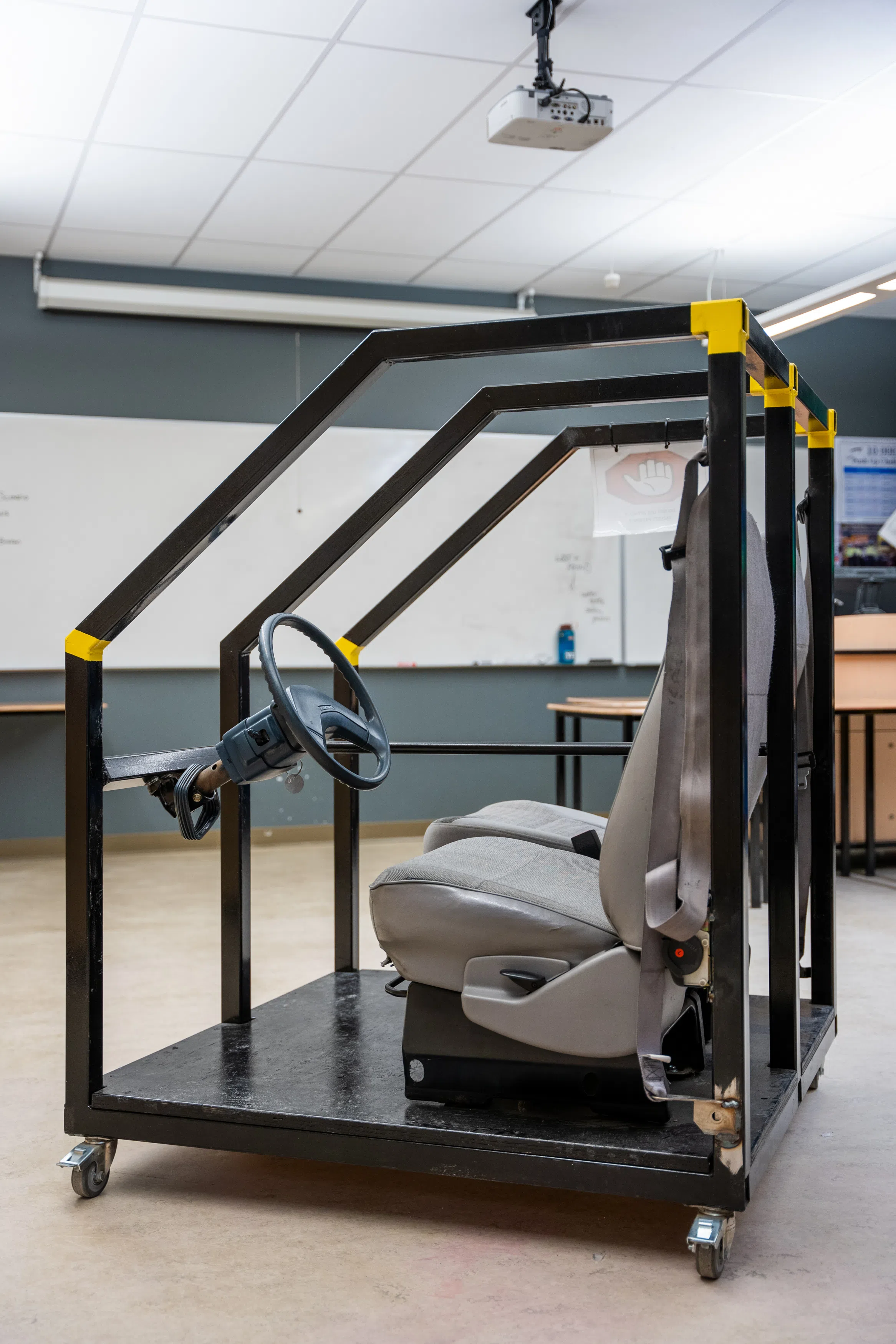
Confederation College has announced that they have acquired a new vehicle extrication trainer.
The new instructional tool will enhance and expand the hands-on learning experience for students in the paramedic program.
The device built in collaboration with the college’s welding program faculty can be positioned on its side, roof, or back, simulating real-life emergency extraction scenarios they were previously unable to do. It can also be utilized as a useful education tool in non-extraction scenarios.
Equipped with heavy-duty casters and locking mechanisms, it ensures the safety of the students while providing the flexibility to be moved across rooms or buildings. This approach is expected to significantly boost the readiness of students for real-life rescue operations.
“Getting people that are seated in a vehicle’s front seat, back seat, whatever and removing them safely if they have a neck or back injury is part of our syllabus and the time that we use that is usually generally in November,” explained Program Coordinator Rob Plummer. ” It becomes colder, more inhospitable for us to work out with real vehicles, and so we found that we’re having the experience of students going out there with the best of intentions, but it’s -15 or -16 outside and sometimes it’s snowing or raining and it just became there was a ceiling on the amount of time that they could actually do well and our lab times are about four hours, so they’d be out there and getting chilled and we’d have to come to take breaks.”
That’s what gave Plummer and fellow staff the idea of improving the education experience.
Research informed the professor that there were commercial vehicle extrication trainers available. Those trainers were comprised of a frame of a vehicle with two seats inside of it, a steering column, seat belts and a person or manikin.
“We really kind of fell in love with the idea that we’d be able to do vehicle extrication training or patient extrication training from vehicles indoors, so we we looked a little bit further at it and it was just financially, it would be a financial hardship for us to do,” explained Plummer. “To purchase in a lot of the places that they were making these devices where the United States and of course with the Canadian dollar and also shipping it became a very untenable cost of like five to 10 thousand dollars was our prediction to make it happen.”
That’s what led to the collaboration with the welding program.
“We approached our welding shop and we just had sort of a general concept drawing of what we wanted to do, an image of what it is ultimately, what we’d like it to look like,” said Plummer.
“They actually for a very reasonable low cost, these super talented staff and students from the Welding Department built this for us, painted it, put the seats, everything. It was just it was just a great project and we’ve actually instantly put it into practice and we’ve been using it ever since.”
Ultimately the in-house trainer only cost a few hundred dollars, and the program hopes it will make it through 10 years of service.
Welding Techniques Program Coordinator Blair Bamford, agreed that it was a great collaborative effort. “We worked closely with the Paramedic program to design and construct this trainer. By repurposing materials and pooling our expertise, we created a versatile tool that’s already making a difference in the way the Paramedic program can offer learning.”



